Addendum: Plural Affordances
An essay on plural communication practices, and the design concerns therein
When reading posts online, I often find myself imagining the speaker as the avatar they use to represent themself. This varies depending on platform and how representative a particular profile picture is, and I can work against this habit, but it is at least partially an instinctive response for my brain.
I'm aware this does not hold for everyone - many people make choices with their digital representations that suggest the contrary. But I think for a substantial proportion of people living their lives online, their experiences are similar to mine - you associate people with their avatars, to at least some degree.
The thing about plurality however, perhaps its defining feature, is a distaste for holding a singular stable identity. While it is possible to simply change features of your online presence along with each change in identity, any frequent switching between repeated states gets annoying.
Hence, tools like PluralKit emerge, hacking existing communication tools (in this case Discord) to represent multiple identity states.
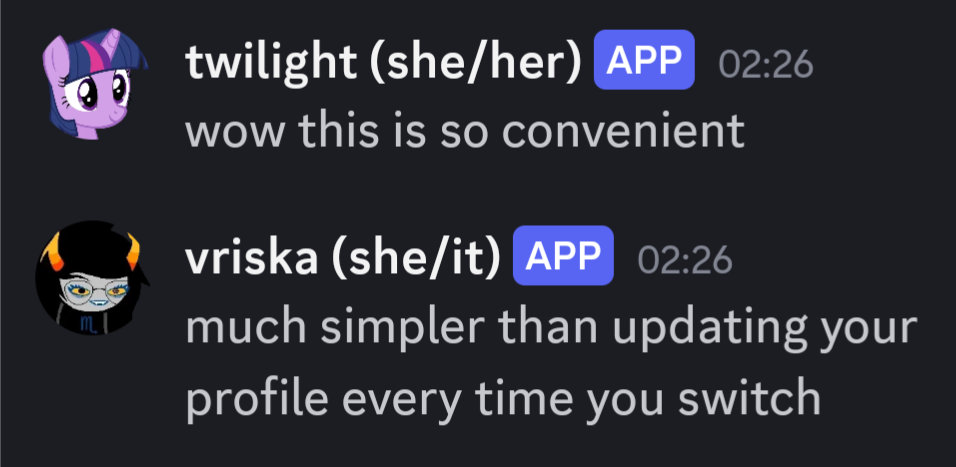
Having the ability to directly and easily associate different images and names with messages genuinely provides so much in the way of identity expression, making any platform where this is possible far more appealing to communicate with.
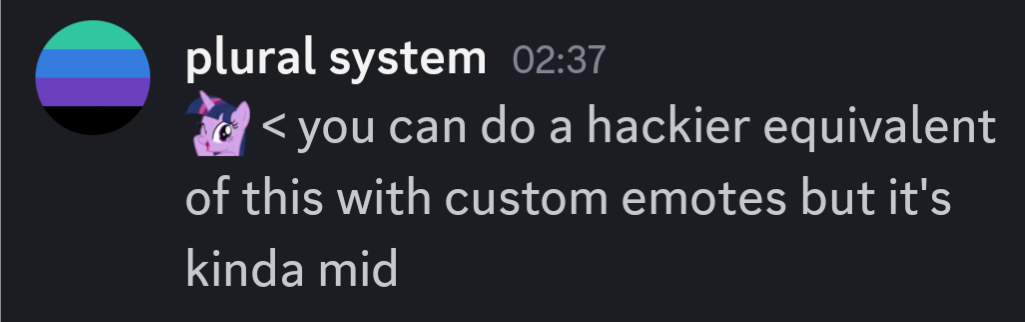
The difference in expressive possibilities here becomes obvious if you spend much time in plural spaces;
- Users who proxy as the wrong person will frequently comment on how wrong it feels seeing a message come from someone else's "mouth" especially when it would be out of character for them.
- On the other hand, a message being proxied can help cement a weak front, or even pull someone into front (in the case of a misproxy).
- Even in person, sometimes switching to communicating over a text chat with proxying can help elucidate fronts, or include a back and forth between headmates in a way that's harder to communicate verbally with the one mouth.
Altogether being able to see your own name and face with your messages can help with actually feeling plural - making those differences between your selves visible and legible. While there are a number of other tells someone might distinguish fronts by, and the models established by tools like PluralKit won't work for every system, it's an invaluable tool to have at your disposal.
We might want to theorise that this is simply replacing the tells you'd get speaking to a system in person; different voices, posture, demeanour - the tone missing from text communication replaced with explicit headmate signifying. But I would argue this type of text affordance actually offers up entirely different plural communication possibilities.
For example, it's straightforwardly possible to interact with someone in ways you can't in person:
headmate 1: ooooh im hugging u
headmate 2: ooooh hugging you from the other side
While you can still do this without proxy support, the affordances of a tool like PluralKit make this much easier to depict and more appealing. It feels more satisfyingly real, at least in our experience. And that makes sense, given each headmate is being put on the same representative footing as a whole separate user, rather than being depicted as the whole system/body first.
In fact, for many people questioning their possible plurality, I'd actually recommend experimenting with PluralKit to explore your identity.
Plurality, like gender, is social. While there may be underlying experiences and identity (and a closeted transgender person/system is still transgender/plural), a huge part of trans/plural experience is realised socially. Asking someone to use a different name or pronoun for you, asking them to use more than one name! - these create a social reality in which you are recognised as your gender/as multiple. Experimenting with these identities in private and then with people you trust can be a really important avenue for self exploration.
And when a service allows you to easily and naturally present as multiple people, this instinct to treat people as their representations does a lot of heavy lifting. When I first started interacting with systems online I straight up did not think very hard about what plurality meant - I got shown the different avatars, names, pronouns, and interacted accordingly. Similar to how online spaces are often a safe haven for trans people exploring their genders, being able to choose a presentation detached from judgements about their physical bodies.
This better sense of plural embodiment also shares a lot with non-human uses of the same tools. Many people treat their avatars like a representation of the self and make them a fursona, or a hot demon girl, or whatever they'd most like to be perceived as. This ability to adopt a form that represents something other than your body is a conceptual step towards multiplicity. And there's a lot of overlap between the tools someone might use for both.
A good Minecraft skin, especially one with more species-affirming traits (try ears), mods implementing species-affirming abilities (like origins-), and tools to fluidly switch between them (see switchy) can do a lot for both plural and non-human embodiment in a virtual game space (we literally found a headmate as a result of playing with these particular tools). I know other systems who swear by VRChat, and using different avatars there to let headmates feel embodied. These are general principles that can be ported to the design any multi-user communicative space.
What matters is taking the tools of self representation; display names, avatars, etc. and treating these like interchangeable presets, with robust tools to fluidly switch between them. The more natural you make plural communication, the easier it is for systems to discover themselves, be out, and be accepted by the spaces around them.
And while I've lauded PluralKit here as the prototypical example of these technologies, It's nature as something hacked onto an existing chat app has clear weaknesses, and we can in fact imagine a world where this kind of chat support is better.
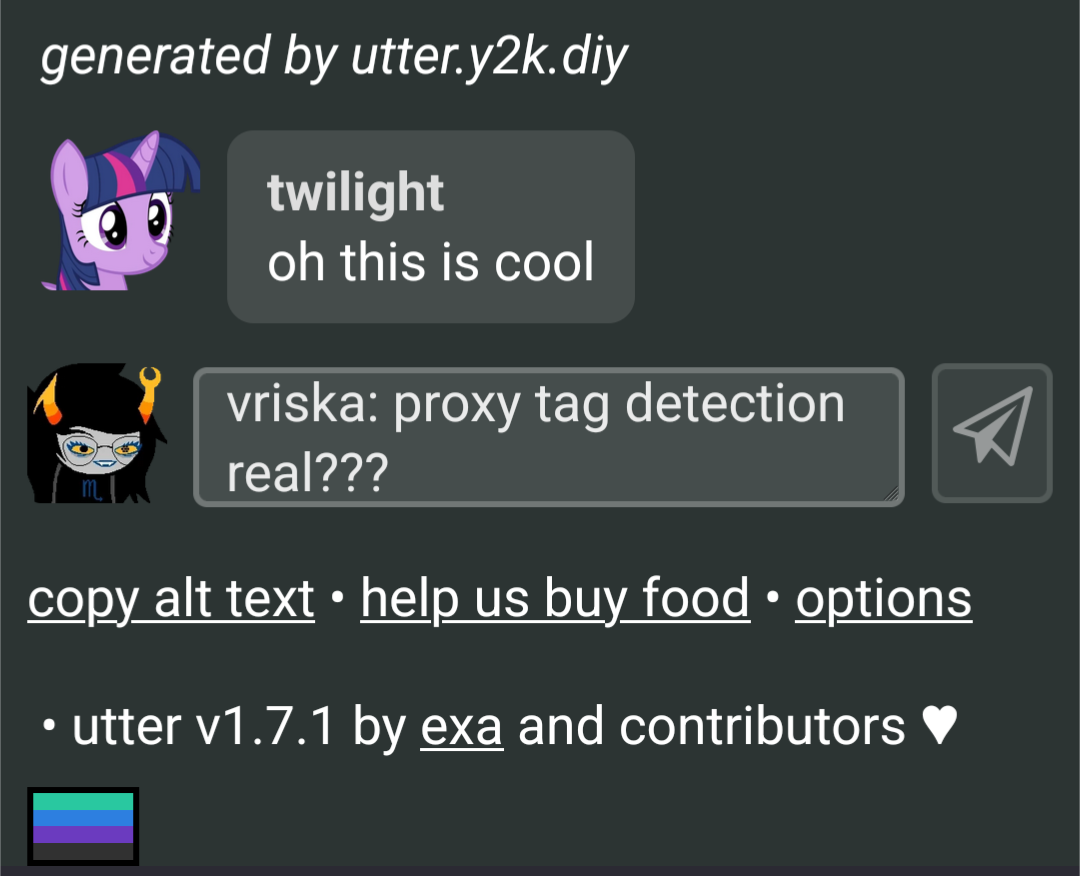
For example, a tool like utter, while not a networked messaging app, can show you the avatar of the person you're about to post as. This hedges against accidental misproxying, helps you check if you've remembered the right proxy, and helps address a not uncommon plural problem of "wait I'm not sure who's writing this, I wish I could test out different options without having to hit send first".
In conclusion, if a plural friend asks you to use discord because they find it easier to communicate when they can use PluralKit, please give them that chance, because it does make a genuine difference. When we have had to try and bridge the gap of plural communication over tools with none of these affordances, there's been a real and perceptible flattening done to our expression. But we can also build better tools if we design with plurality in mind, and I think that's something our communities deserve. These tools don't only serve pluralfolk, as the space to temporarily try on new forms and identities can help a whole range of identity exploration. Even if the space to play with fluidity of self resolves to a singular identity that does not make the exploration less valuable. Plurality simply makes these needs most evident.
-mk